The Latest from Sheela
Part 1: What's Up With All the Signs, BSO?

THE WHAT AND THE WHO
HE WHAT AND THE WHO
South Berkshire County drivers can not have helped but notice the new red and blue lawn signs popping up along roadsides and in medians. Using the Obama “Hope” style of artist Shepard Fairey, the signs say “Stand with Andris” and “Reinstate Andris” and feature the smiling image of twelve-year Boston Symphony Orchestra music director Andris Nelsons.
His contract, as announced on March 6 in a statement from the BSO's board of trustees, chaired by Barbara Hostetter, was not renewed beyond 2027, with the explanation that he and the orchestra “were not aligned on future vision.” Since then there’s been an energetic and sustained effort to restore Nelsons to his job, and it involves thousands of signs, posters and cheap red flowers procured by devoted fans, dispersed first in Boston and now, as the BSO has moved to its Berkshires summer home, in the small towns in and around Lenox. The movement has been further buoyed and bolstered by the fact-checking of a skeptical statistician.
The objections at the center of the Red Flower protest relate to three things: the way the BSO made and presented the decision not to renew Nelsons’ contract, the ways in which they’ve since justified the decision, and the fact that leadership apparently made the decision with no plan for what comes next for one of the most venerated orchestras in the nation.
As the BSO season ramps up at Tanglewood, so has the scale of the campaign. If you happen to stop in for a coffee at the new coffee shop in Stockbridge, you can educate yourself on the issues and questions at hand, because they’re pasted all over the windows and doors of the old coffee shop. The colorful products of the Red Flower Campaign, in fact, seem to be everywhere you turn, and locals would be forgiven for assuming that the conductor is running for public office and is blessed with an extraordinarily well-resourced and expansive staff.
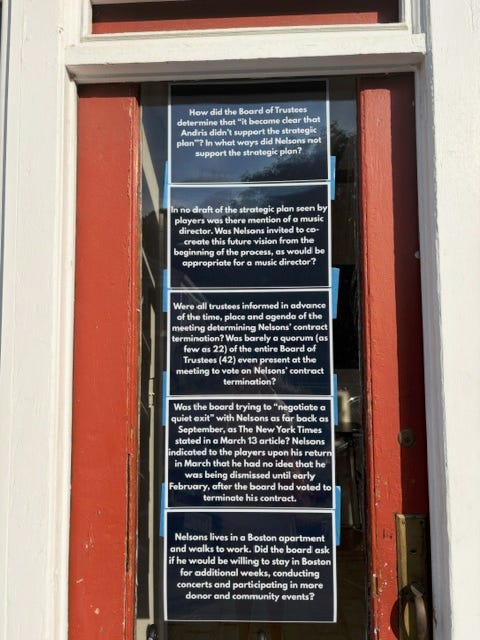
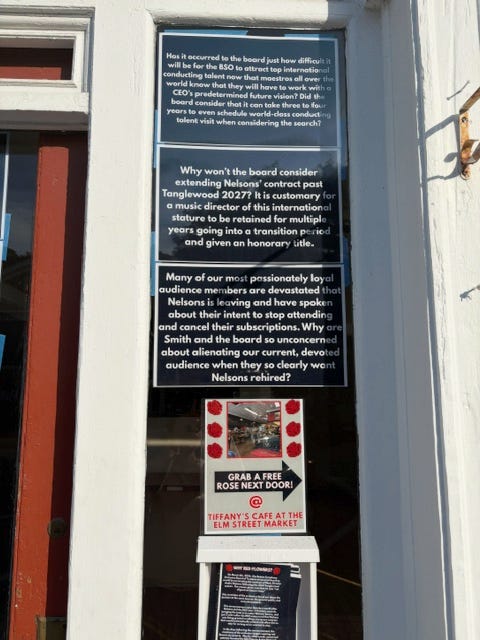
Sadly, there’s rarely such enthusiasm oriented toward political figures these days, so that impression would be mistaken. Also, there’s no paid staff for the Red Flower campaign.
In fact, it was started by just two fans — George Whiting and Quinn MacKenzie — using their own money and $10 and $20 bills pressed into their hands here and there, along with the design power of Canva, a free drag-and-drop website popular with PTA newsletters, the discounted reproduction services of Staples, and Amazon bulk shipping. This morning in Lenox, as music students with plastic red flowers pinned to their tee-shirts were walking from the Boston University Tanglewood campus down the hill to listen to the 10:30 rehearsal, MacKenzie and other volunteers were standing out at the top of the hill at the entrance to town, while Whiting and volunteer Steve Landrigan, both just arrived from Boston, were standing out on the Yokun Avenue lawn of still another campaign supporter, wearing tee-shirts, holding signs and handing out red flowers to the drivers who honked in support and stopped to take them.
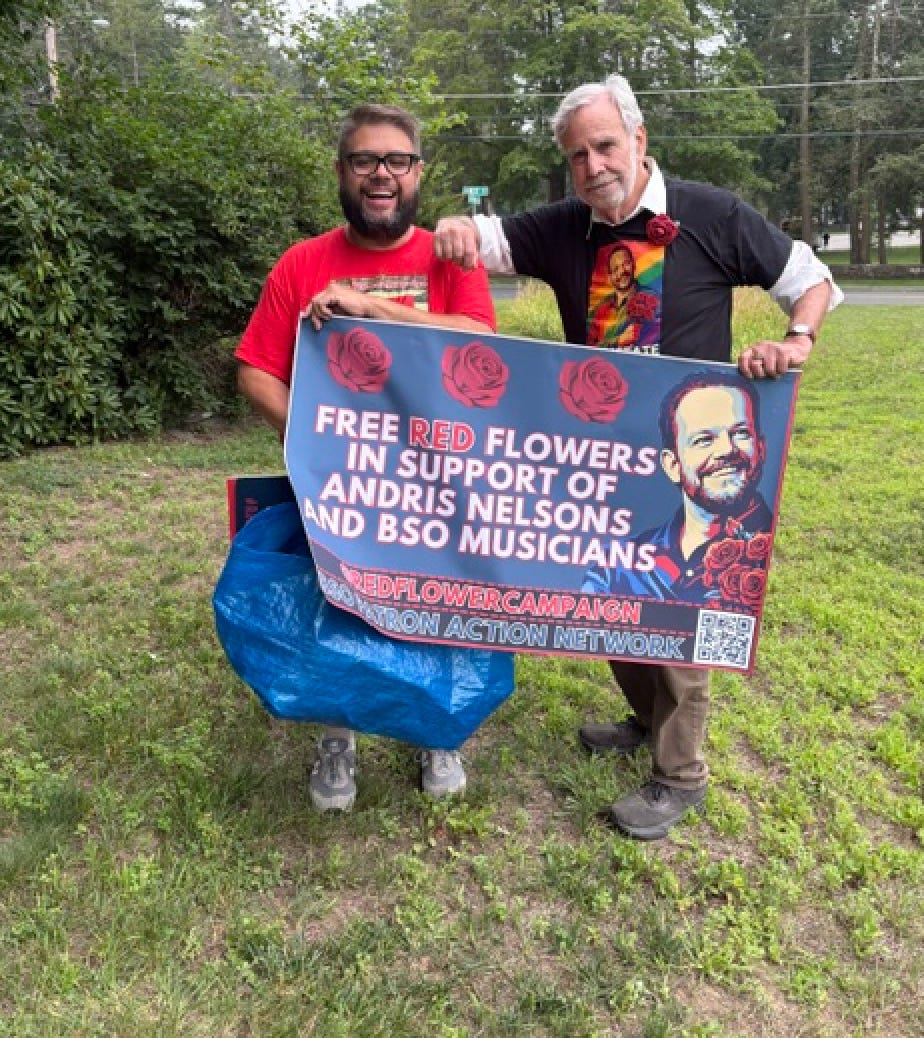
BSO leadership’s responses to the furor have clearly not helped things. After the March 6 announcement about Nelsons’ dismissal, criticism among BSO staff and musicians magnified so quickly that leadership soon felt the need to explain themselves, which they did by pleading poverty. Citing the need to address “existential issues,” they wrote in an open letter to the Players Committee reported by the Berkshire Eagle that attendance had drastically declined over the past two decades, they’d been operating with budget deficits, and that they’d drawn down $100 million from their endowment.
But according to business analyst Thomas Dinsmore, whose substack has recently been given over to covering the drama, this was not the case. He’s just done an analysis of the BSO’s 2025 fiscal year 990 tax filing and found instead that all three of the BSO’s revenue engines — program services, contributions, and endowment returns — were firing at once. Ticket and subscription revenue hit new highs despite lower attendance numbers in the wake of COVID, fundraising set a record, and investments rode a strong stock market wave.
Dinsmore further claims that leadership knew when they wrote the letter that 2025 was shaping up well.
“They were saying one thing, but they knew it wasn’t true,” Dinsmore said in an interview.
Though he attended Tanglewood through Boston University in 1971, Dinsmore has not been affiliated with the BSO since then except as a fan and a patron. He, like so many others, was spurred to action by Nelsons’ removal, and has now published about a dozen critical pieces of the mismatch between the orchestra’s finances and its public statements.
(The BSO has not responded to his claims, and when asked to comment for this story declined to do so.)
The idea to wear the roses originated with BSO bassoonist Suzanne Nelsen who began wearing them and handing them out after March 6. (Red matches the predominant color of Latvia, Nelsons’ home country.) Whiting and Quinn MacKenzie were also looking for an effective means to show their dissatisfaction, and saw the roses on the lapels of musicians in Symphony Hall. Knowing that nobody attending a concert in fancy clothes wants to pull a protest t-shirt over their jackets, they thought to go with the rose theme. They handed out roughly 3,500 during the regular season, about 500 more at Carnegie Hall, and — after this weekend at Tanglewood — nearly 5,000 total, with 4,000 more waiting in Stockbridge.
Boston resident Whiting is an unlikely agitator. He plays piano and has been a BSO patron for fifteen years, but hasn’t done any activism since Hillary Clinton’s 2016 campaign. He spent years in corporate America running global acquisition teams before a cancer diagnosis reordered his priorities. “I thought, ‘I want to help people.’” Now in remission and two months from finishing massage therapy school, he found a new and unexpected way to help people after March 6.
That background matters because of what BSO leadership has reportedly been saying about Whiting and MacKenzie. According to Whiting, the board has been told the Red Flower campaign is not a grassroots effort, but is secretly backed by the orchestra’s former CEO and Nelsons’ own team.
“Patently false,” Whiting insists. “I have receipts that they’re not involved at all. Why would they put themselves in jeopardy? Their livelihoods are on the line.” The campaign has also been accused of “weaponizing” Tanglewood students and fellows, but Whiting says that the young musicians themselves have approached organizers again and again, asking for roses and free shirts.
Board Chair Barbara Hostetter is a formidable figure in Boston philanthropy. She and her husband underwrite the Barr Foundation, which has played an outsized role in funding education and the arts in Berkshire County in recent years, especially through the lens of diversity, equity and inclusion. For many years Barr has supported Berkshire Taconic Community Foundation’s efforts to diversify audiences for local arts venues through its Art Build Community program, and Barr has given over one million dollars in grants to fund programmatic redesigns in Berkshire Hills Regional School District, including work in proficiency-based instruction and assessment, expanding student voice, and social-emotional learning.
Given Barr’s history of commitment to such work, the Red Flower Campaign’s Whiting says he is confused by the attitude of the woman behind it. “It surprises me that Barbara, who believes in so many progressive liberal causes, also believes that we’re somehow not a grassroots, patron-led organization. We’re organizing at the fundamental level of what it means to build community.”
The BSO’s official explanation for cutting ties with Nelsons — the “difference in vision” — hasn’t landed with the public in part because no one, apparently including Nelsons himself, seems to have seen a BSO vision to compare with his.
Dissent inside Symphony Hall/Tanglewood’s administrative offices is tamped down by fear, but orchestra members, protected by their union contract, have spoken out. In May flutist Elizabeth Klein wrote her thoughts for the Berkshire Eagle from the musicians’ perspective, and pressed especially on the BSO leadership’s failures of communication.
Since the March 6 announcement, Smith and the Board have continued their established practice of not communicating well with the orchestra on critical issues. There has been little substantive communication outside of attempted explanations made to the press and major donors. Smith has also declined to participate in the frank and difficult discussions taking place in negotiating the players’ trade agreement, as is customary in the industry, despite players’ invitations.
BSO staff, however, are staying mum, as they’re “scared to death” of being fired, according to Dinsmore.
Nelsons himself is constrained by non-disclosure agreements, but his team’s first extended comments surfaced last week in a letter from management representative Karen McDonald to BSO musicians, and obtained by the Eagle. Clarence Fanto quoted McDonald’s dispute with the BSO leadership’s version of events, which she called, “inaccurate and not a faithful reflection of the truth.”
For the Red Flower contingent the third and final grievance, and the “biggest unforced error,” as Thomas Dinsmore puts it, is the absence of a plan for the BSO’s future and a replacement for Nelsons. President and CEO Chad Smith has said a search cannot begin until union contract negotiations conclude in August, but music director searches can take many years, and top conductors are booked two to three years out. Other orchestras manage such transitions gradually, easing an outgoing director into an emeritus role while a successor is courted. Instead, as things stand now, Nelsons will finish the 2026–27 winter season and Tanglewood 2027, and then the podium goes empty. Musicians, Dinsmore says, “fear that without a music director, the quality of the orchestra will decline rapidly."
Beneath the surface complaints runs a deeper anxiety about what the renowned 145-year-old institution is becoming. Critics describe a board populated less by people who value symphonic music than by people who value the prestige of proximity to it, and a CEO who lights up when talking about Tanglewood’s popular artist bookings, which feature ever-starrier names every year, and stretch from late June into September, while saying comparatively little about the orchestra itself.
With little concrete information to go on to explain why the BSO is choosing to change out a popular captain, Thomas Dinsmore compared the orchestra to a house to describe his impressions.
“It feels like BSO leadership walked into the living room and said, ‘This is dowdy. We just need a makeover’ — and that was it.”
That’s the what, when and who. Tune in for Part 2, later in July, for more about the why.